
New-language audiences, without booking the studio again
Translate interviews, explainers and shows into new languages, in the presenter’s own cloned voice, with every line editable before it goes out under your name.
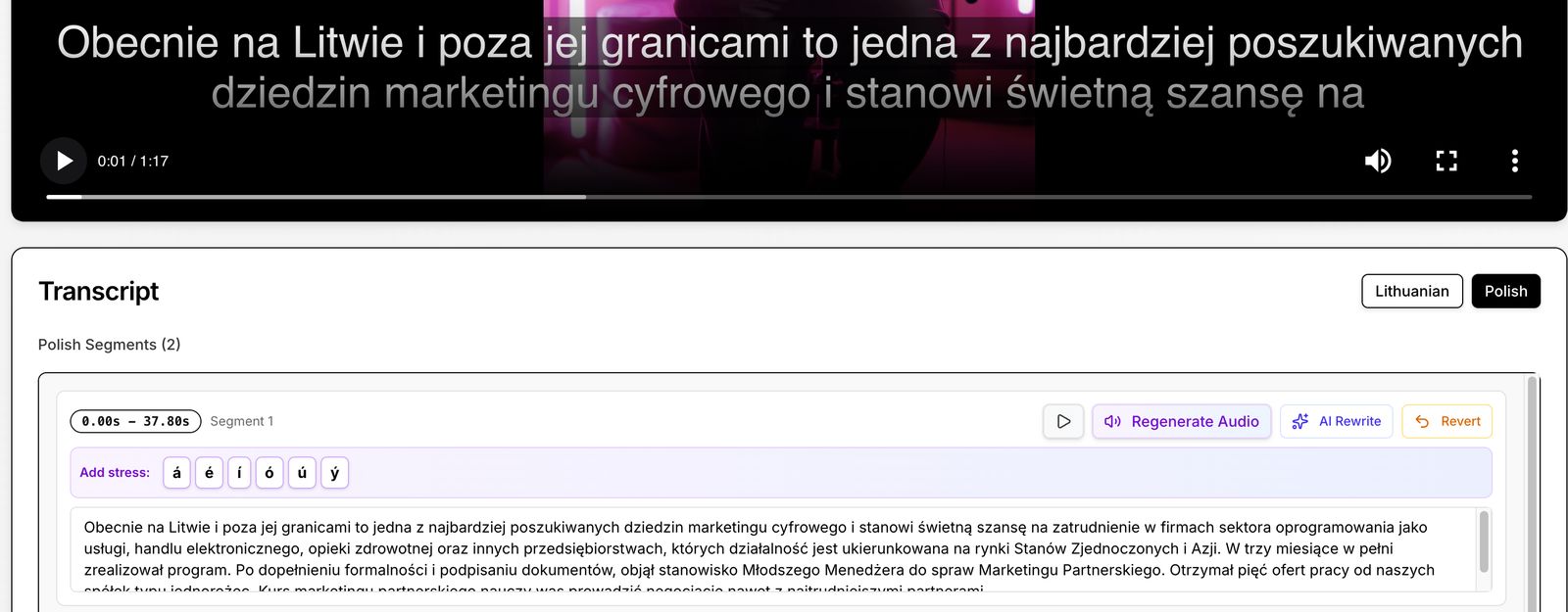
Volume, speed and editorial control, all at once
An archive is worth more in three languages than in one. The problem is that none of the usual routes survives daily output.
Studio dubbing does not scale to a weekly schedule. Subtitles lose a mobile audience. And you cannot publish what nobody has read: every translated line needs an editor before it carries your masthead, which is exactly the step that fully automatic tools remove.
How it fits an editorial workflow
Upload the finished cut
One piece at a time, or the week in a batch.
Translate speech and on-screen text
The presenter’s cloned voice, subtitles and any on-screen text in each target language.
Edit it like copy
Change a line, fix a name, and the subtitles and the voice follow the edit.
Approve and publish
Export when an editor is happy with it, in the formats your platforms take.
The part that stays editorial
Translation is where meaning quietly changes. A name, a number, a claim attributed to the wrong person: these are not model failures, they are the reason an editor exists.
So the workflow puts the transcript in front of a person and regenerates the audio from the edit, rather than asking anyone to accept a finished file and hope. Your style guide’s terms live in a glossary, so the things you have already ruled on stay ruled on.
Rights and disclosure
Only send material you have the rights to, including the presenter’s permission for their voice to be used.
If you publish AI-generated or manipulated audio and video in the EU, transparency duties fall on you as the publisher. We keep the record of what was produced; the disclosure to your audience is yours.
Questions media teams ask
Can our editors change lines before publication?
Yes. Every line is editable and the translated audio regenerates from the edit, so a correction takes seconds instead of a session.
How fast is it at volume?
Bulk upload handles a batch rather than a file at a time. For a turnaround you can build a schedule around, bring a real week of output to a demo and we will measure it rather than estimate it.
What happens to music and background audio?
Ask us with a real cut. It depends on how your audio is mixed, and an answer that ignores your mix would not be worth much.
Does edon.ai support videos with more than one speaker?
Yes. Multi-speaker videos are supported, and each translation stays aligned with the correct speaker.
What are our obligations when we publish AI-translated video in the EU?
They sit with you as the publisher, not with your tools. Our guide to the EU AI Act transparency rules walks through who has to disclose what. We keep the records of what was produced; the disclosure to your audience is yours to make.
Send us a segment
One finished cut is enough to tell you whether this belongs in your workflow.